
.svg)
SIGN UP FOR JUICEBOX (IT’S FREE!)

Who are you looking for?
Thank you! Your submission has been received!
Oops! Something went wrong while submitting the form.

Talent evaluation is the engine behind every great hire. It’s the systematic process companies use to screen, assess, and select applicants based on their skills, experience, and potential.
Done right, it means moving past resumes and structured interviews and data driven recruiting to make objective, predictive hiring decisions that build world-class teams.
This guide provides a complete framework for a modern talent evaluation process.
Most leaders think their biggest hiring problem is a shallow candidate pool. Nine times out of ten, they're wrong. The real bottleneck isn't sourcing—it's an outdated, resume-obsessed talent evaluation process that lets the best people slip right through your fingers.
Let’s be honest: relying on resumes is slow, riddled with unconscious bias, and a terrible predictor of on-the-job performance. A candidate’s knack for writing a compelling resume rarely translates to their ability to build great software or lead a team.
This old-school approach creates a domino effect of problems:
The bottom line?
By shifting your focus from credentials to capabilities, you build a system that consistently surfaces top performers.
As you explore how to move beyond resumes, it's worth getting familiar with modern assessment tools. For example, understanding what a case study interview entails shows you how practical simulations can reveal skills in a way no resume ever could.
An effective talent evaluation strategy also has to pull from a diverse, multi-source candidate pool, which is why AI recruiting tools are becoming essential.
The heart of modern talent evaluation is a strategic pivot—from reviewing past experience to predicting future performance. It's about de-emphasizing the resume and prioritizing objective signals of skill and potential.
Companies like Ramp and Perplexity have mastered this, hiring world-class talent by focusing on what candidates can do, not just what they've done. They build evaluation frameworks that measure concrete skills and behaviors tied directly to success in the role.
This flow shows how the best teams are moving away from resume reviews and toward a focus on skills and proven performance.
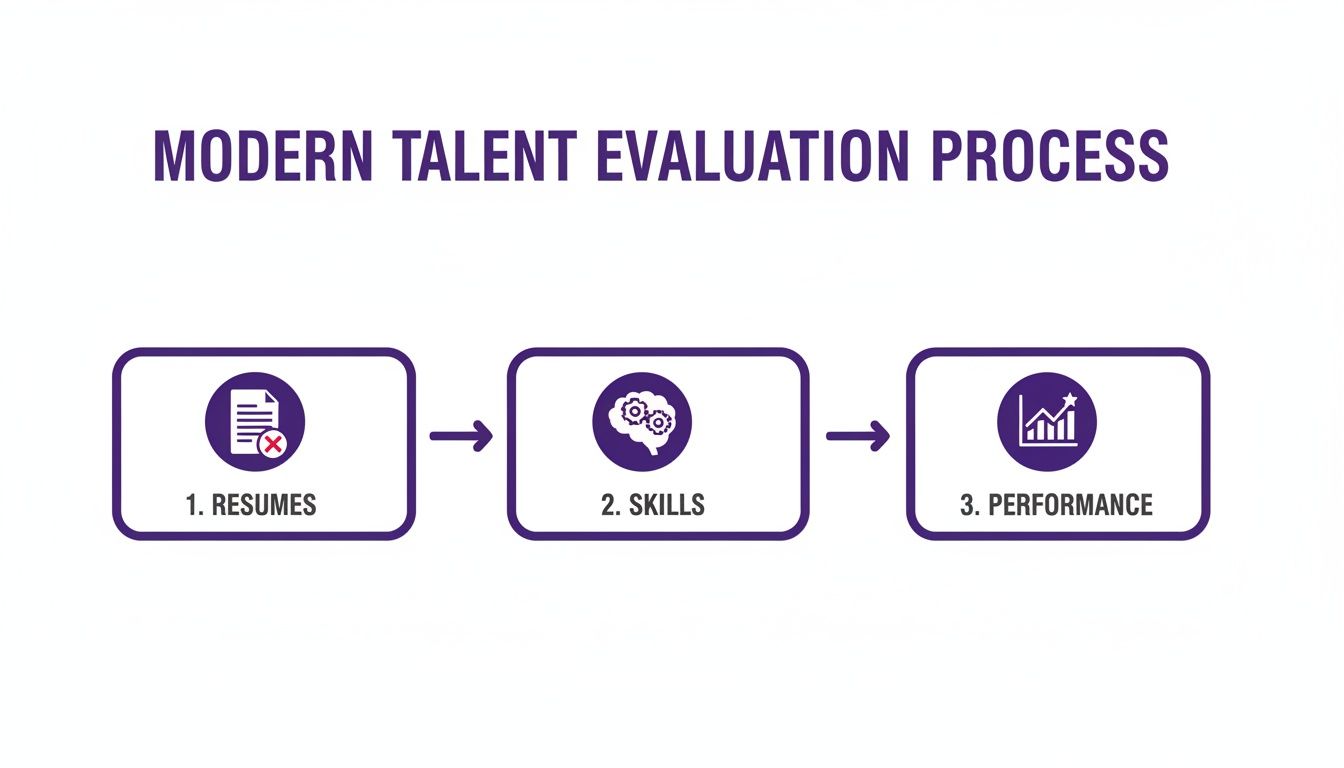
So, what does this actually look like day-to-day? It starts with a deep, nuanced understanding of the skills required for success—not just a list of keywords. This guide will give you the playbook to build that system. If you want to dive deeper into the fundamentals, check out our guide on skills-based hiring. Adopting this mindset will help you build a hiring machine that's faster, more accurate, and fundamentally fairer.
Great talent evaluation doesn’t start when the first resume hits your inbox. It begins way before that, with a crystal-clear, shared definition of what success actually looks like in the role.
Without this foundational blueprint, you're flying blind. Every decision becomes subjective, interviews devolve into unstructured chats, and sneaky biases creep in. The goal is to create a single source of truth that gets everyone—recruiters, hiring managers, and interviewers—on the same page.
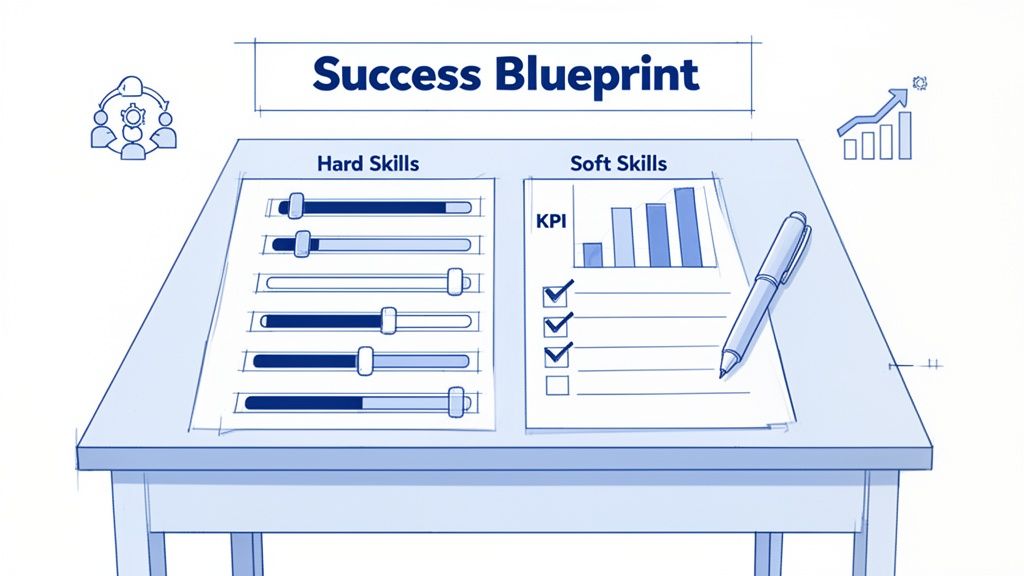
This isn’t about rehashing bullet points from the job description. It’s about a deep, collaborative dive with the hiring manager to codify the skills, behaviors, and outcomes that truly drive success. We've talked before about how to write a good job description, and this blueprint is the strategic layer on top. It becomes the bedrock for everything that follows, from sourcing to the final offer.
First things first: you have to separate the absolute essentials from the desirable extras. Hiring managers often come with a long wishlist of skills, but not all of them carry the same weight. A solid talent evaluation framework forces you to prioritize.
Work with your hiring manager to bucket every skill into one of two categories:
This simple sorting exercise brings incredible clarity.
With your skills defined and prioritized, the next move is to turn them into a quantitative tool: the weighted scorecard. This is your best weapon against bias, ensuring every candidate is measured against the exact same yardstick.
A powerful scorecard has three core elements:
Before you start sourcing, you need a clear definition of what "good" looks like. Here's a simple framework to build out a comprehensive Role Success Profile.
This structured approach transforms interviews from casual conversations into focused, data-gathering sessions. Research from Schmidt & Hunter has shown for decades that structured interviews are one of the most powerful predictors of job performance. A well-defined blueprint and scorecard make it happen. You can also explore flexible work options like a 9-80 work schedule to attract a wider talent pool.
The most critical decisions in the hiring process happen right at the beginning. This top-of-funnel stage is where you must find the real signal amongst the noise. It's also where most hiring processes fall apart.
The Myth: Most people believe more sourcing activity equals a better pipeline.
The Reality: The opposite is true. High-volume, low-precision sourcing floods your funnel with unqualified candidates, forcing recruiters to spend 80% of their time screening instead of engaging with high-potential talent. Precision beats volume, every time.
The answer isn't to work harder; it's to work smarter. You need to equip your team with the right tools to spot excellence in an instant.
For years, screening has relied on clumsy Boolean strings and basic keyword matching. But there’s a problem most tools ignore: this approach assumes a person's resume perfectly reflects their true capabilities. We all know that's not the case.
Modern talent evaluation flips this on its head, shifting the focus from keywords to tangible achievements and career velocity. Instead of asking, "Does this profile have X keyword?" you should be asking smarter questions:
This is where AI-powered tools give you a massive advantage. Imagine describing your ideal candidate in plain English—"a former founder who has built and scaled a fintech product from zero to one"—and immediately getting a ranked list of the best matches. For a deeper dive on this, check out our breakdown of effective candidate matching.
You might think building a sophisticated process like this requires a huge team or a suite of complex software. But what we've seen at companies like Ramp and Perplexity is that this line of thinking often fails. A small, focused team armed with the right AI tools can run circles around massive recruiting departments stuck in the old way of doing things.
Take Perplexity, for example. They hired 15 world-class AI researchers in just 60 days by using PeopleGPT to pinpoint talent with specific, verifiable achievements, completely bypassing the noise of traditional sourcing channels.
This strategy is more important than ever. For instance, global talent mobility among skilled professionals slowed by 8.5% in 2025, while emerging tech hubs in the UAE and Saudi Arabia saw a huge influx of top-tier STEM talent. If you're only relying on Indeed, you're missing these new global hotspots entirely.
Interviews are the moment of truth in any talent evaluation. They’re also, unfortunately, often the weakest link. Too many interviews devolve into unstructured chatter and gut feelings that do a terrible job of predicting who will actually perform on the job.
The fix isn't just more interviews; it's better interviews.
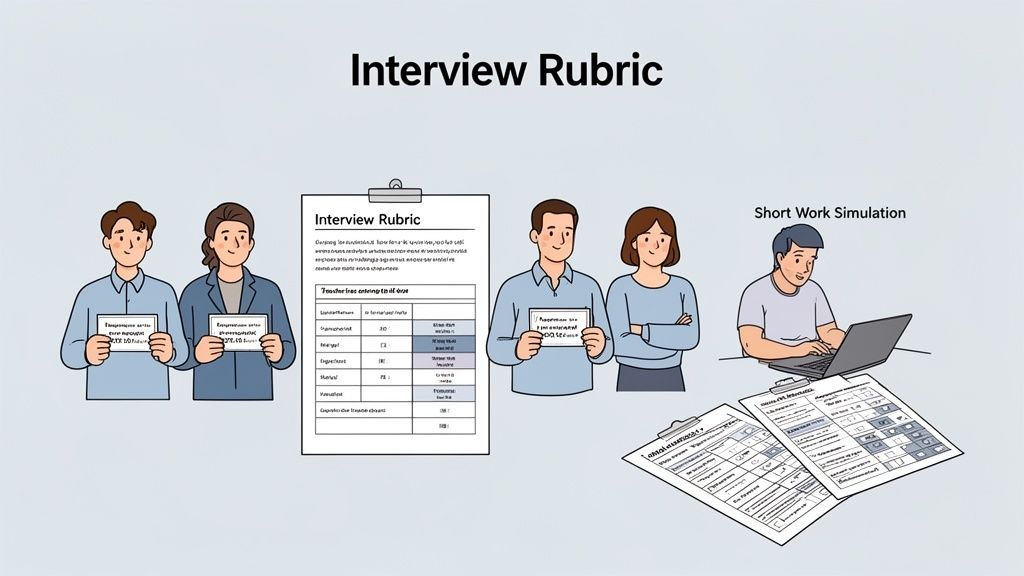
Your goal should be to turn them from subjective conversations into objective, data-gathering exercises. This is where structured interviewing comes in. It’s a simple but powerful idea: ask every single candidate the same role-specific questions and score their answers against the same predefined rubric.
But there’s a catch most interview guides seem to miss. Simply asking the same questions isn't enough if the questions themselves are weak. The quality of your questions directly dictates the quality of your evaluation data.
To get beyond canned, surface-level answers, your questions need to probe for real evidence of past behavior and test future problem-solving skills. A great interview loop blends two types of questions to get a complete picture.
1. Behavioral Questions: These work from a simple premise: past performance is the best predictor of future performance.
2. Situational Questions: These present a realistic, hypothetical scenario they might actually face in the role.
By standardizing these high-signal questions, you gather comparable data points across your entire candidate pool. This makes your debriefs far more productive and data-driven. For a deeper look, check out our guide on how to streamline your recruitment process.
As powerful as structured questions are, nothing predicts performance quite like seeing someone actually do the work.
A well-designed work sample gives you incredible insight while being respectful of a candidate's time.
For an engineer, this might be a 90-minute live coding session. For a product manager, it could be a short take-home assignment asking them to write a product brief. The key is to make the task relevant, time-boxed, and focused on the job's core skills.
Your process is only as strong as the people running it. An untrained interview panel can unintentionally introduce bias, even within a structured system.
To fight this, hold a brief training session before each interview loop kicks off. Remind the panel of common biases, review the role's success blueprint, and get aligned on the specific skills each interviewer is responsible for assessing. This simple step ensures the final hiring decision is based on a collection of structured, independent data points—not just one person's strong opinion.
Let's be honest. In today's market, your next game-changing hire could be anywhere in the world. Yet, most companies are still fishing in the same local, over-fished ponds. This isn't just outdated—it's a massive strategic disadvantage.
The reality is, exceptional talent is globally distributed. Thinking your search is best confined to your local city ignores the explosion of remote work and shifting mobility patterns.
What’s the alternative?
It’s about making a strategic shift from reactive, location-based sourcing to proactive, data-driven global talent mapping. You need to understand where the skills you need are concentrated, where they’re emerging, and how you can get there first.
So, where do you start? The key is to let market insights inform your sourcing strategy before you write a single boolean string.
Recent data paints a clear picture. According to the 2023 Global Talent Competitiveness Index (GTCI), Switzerland snagged the #1 spot for its ability to attract and retain talent for the tenth year running.
While Europe dominates, emerging economies are making huge strides. China has become a "talent champion," and Indonesia is the top improver among developing nations. These trends highlight the massive opportunity for companies willing to expand their talent evaluation strategies beyond traditional Western markets.
The real question is: how do you translate these high-level trends into a pipeline of qualified candidates?
The answer lies in modern talent intelligence platforms like Juicebox.
Tools with built-in talent insights transform high-level data into a tactical advantage. For any given role, you can instantly see the ground truth for any market in the world.
Instead of just sourcing, you can now analyze:
This data-backed approach moves the conversation with hiring managers from "we can't find anyone" to "based on the data, the highest concentration of affordable, high-quality talent for this role is in Warsaw. Let's focus our efforts there."
By folding these insights into your process, you can proactively tap into undiscovered talent pools and close roles faster than competitors who are still stuck thinking locally.
You can have the most sophisticated evaluation process in the world, but if you aren't measuring its impact, you're just guessing. A truly effective talent evaluation framework isn't a "set it and forget it" machine—it's a living system that needs data to learn and improve.
Look, what gets measured gets improved.
The goal is to track KPIs that prove the ROI of your talent function. This isn't just about reporting numbers; it’s about turning recruiting into a strategic driver of growth.
You don't need dozens of metrics. Focus on a handful of high-signal KPIs that give you a clear picture of how well your evaluation process is working.
Think of it this way: the OECD's 2023 Indicators of Talent Attractiveness found that the best countries attract skilled workers by creating favorable policies. Your evaluation process is your internal policy, and its quality directly impacts who you can attract.
For a deeper dive, check out these additional recruiting metrics that can offer even more granular insights.
How can we reduce bias in our talent evaluation process?
Use structured interviews, skill-based scorecards, and diverse interview panels. The key is moving from subjective feelings to objective signals.
What is the best metric for measuring evaluation quality?
New hire performance at 90 days. It’s the clearest line you can draw between your hiring decisions and real business impact.
Can AI replace human judgment in talent evaluation?
No, and it shouldn't. AI is a powerful assistant for top-of-funnel screening, but the final decision needs human nuance and judgment.
How long should a take-home assignment be?
Keep it under three hours. Respect the candidate’s time, or the best ones will simply walk away. Be clear about expectations upfront.
Modernizing your talent evaluation is the single most powerful lever for building a world-class team. By shifting from subjective resumes to objective, data-driven signals, you unlock a faster, fairer, and more predictive way to hire. This means every new hire has the proven skills to make an immediate impact, fundamentally changing your company's growth trajectory.