
.svg)
SIGN UP FOR JUICEBOX (IT’S FREE!)

Who are you looking for?
Thank you! Your submission has been received!
Oops! Something went wrong while submitting the form.

Most talent teams track activity, but elite teams measure the direct impact of talent strategy on revenue and competitive advantage.
Shifting focus from operational metrics like time-to-fill to strategic indicators like Quality of Hire, High-Performer Retention, and Internal Mobility transforms TA from a cost center into a core business driver.
TL;DR: Stop Tracking Noise
Most talent teams are laser-focused on operational numbers like time-to-fill. While that’s an important piece of the puzzle, it only tells you about activity, not business impact. Elite teams know the difference.
The best talent management metrics flip the script. They shift the focus from simple activity tracking to strategic outcomes that directly boost revenue, drive innovation, and improve the long-term health of the organization. Instead of just reporting on how fast you can hire, you start telling a compelling story about how your talent strategy creates undeniable value.
This shift is what earns you a seat at the executive table and proves the ROI of your team's hard work. By mastering a few select metrics—Quality of Hire, High-Performer Retention, and Internal Mobility—you can build a data-driven narrative showing how your talent decisions create a real competitive advantage.
A random list of recruiting KPIs is just noise. A truly powerful talent metrics framework tells a story about your entire talent lifecycle.
By breaking things down across four distinct pillars—Acquisition, Performance, Retention, and Development—you can finally stop tracking busy work and start showing real, strategic impact. This approach makes it crystal clear how each phase, from outreach to leadership training, actually fuels business outcomes.
This first pillar measures the speed and intelligence of how you bring new talent into the fold. Sure, Time-to-Fill is a classic, but the best teams dig much, much deeper.
Here’s what really matters in acquisition:
Once you've made the hire, the focus pivots to their actual impact. Performance metrics are the bridge between your hiring decisions and tangible business results. They're how you prove the TA function's value. The undisputed champion here is Quality of Hire.
Quality of Hire (QoH) is the clearest indicator of recruiting ROI. It blends pre-hire data like assessment scores with post-hire outcomes like first-year performance ratings and manager satisfaction to create a holistic view of a new employee's success.
Improving QoH isn’t magic; it’s a data-driven feedback loop. When you see that new hires from employee referrals consistently knock their performance reviews out of the park, you know exactly where to invest more time and resources.
The infographic below shows how these strategic metrics connect directly to the things your CEO actually cares about: revenue, innovation, and market share.
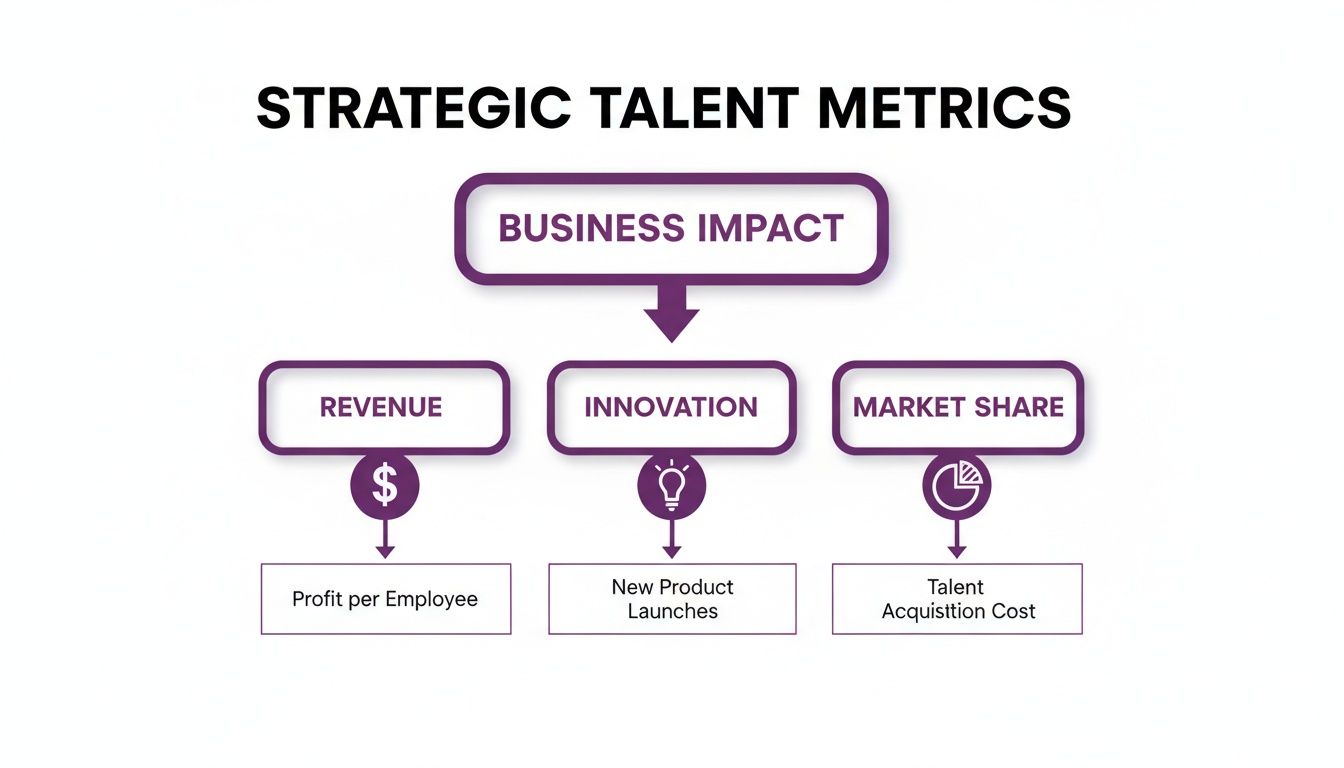
It’s a powerful reminder that tracking metrics in a vacuum is pointless. The goal is to draw a straight line from your talent activities to measurable business growth. To give you a clearer picture, let's map these concepts out.
Hiring and training top talent is an expensive, time-consuming investment. The Retention pillar measures how well you protect that investment. Simply looking at your overall turnover rate won't cut it.
The retention metrics that provide real insight are:
The final pillar answers a critical question: how well do you grow your own talent? A strong internal development program is the secret to building a sustainable leadership pipeline, keeping people engaged, and slashing recruitment costs for senior roles.
The key metric here is the Internal Mobility Rate (IMR), which tracks the percentage of jobs filled by your own people.
This focus on internal growth is more critical than ever. The current talent market is all about movement, with a staggering 44% of professionals globally expecting to change roles within a year, according to ACCA's 2023 report. This trend makes it crystal clear: a competitive advantage isn't just about offering a job anymore. It's about showing a real commitment to career progression and development. Read more on the latest global talent trends.
A healthy IMR sends a powerful message to employees that they have a real career path inside the company, making them far less likely to jump ship for their next opportunity.
If there's one metric that truly connects a recruiter's work to the company's bottom line, it's Quality of Hire (QoH). While most teams are busy tracking things like time-to-fill, QoH is what proves the real value of a new hire. It shifts the conversation from "how fast did we hire?" to "how much impact did this hire make?"
Most TA dashboards skip it because it feels too complex or subjective. The trick is to stop thinking of it as a "feeling" and start treating it like a data-driven index. By blending what you knew before the hire with how they perform after, you can finally put a hard number on your team's ROI.
First, you need a flexible formula. A common mistake is trying to create a one-size-fits-all equation for the entire company. The markers of a great sales executive are completely different from those of a top-tier software engineer.
A solid, customizable QoH formula usually pulls from a few key inputs. Think of it like a balanced scorecard:
When you combine these, you get a clear, data-backed score that tells you how successful each hire actually was. We get into the nitty-gritty of building your own formula in our complete guide to Quality of Hire.
Once you have your formula, a score of "85" is meaningless without context. Start by calculating the QoH for everyone you hired in the last 12-24 months. This gives you an internal benchmark; it shows you what "good" actually looks like at your company.
This is where the real insights surface. You can slice the data to answer powerful questions:
The chart below breaks down how different components add up to a final QoH score.
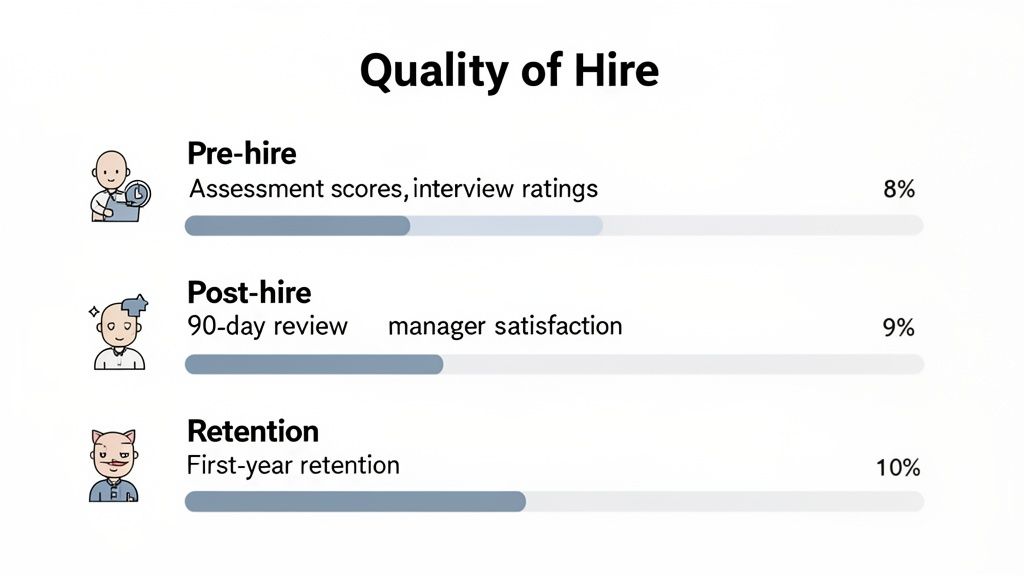
A simple visual like this makes it obvious that factors like retention are having a huge positive impact on overall talent quality.
Let's bring this all together with a practical, weighted rubric that your whole team can use consistently.
Imagine a new hire and score them:
Now for the math:
(0.8 * 50) + (0.9 * 30) + (1.0 * 20) = 40 + 27 + 20 = 87
This hire has a QoH score of 87. When you apply this rubric to every hire, you can start tracking trends, proving your team's value, and making smarter, data-driven decisions that elevate the quality of talent across the entire organization.
Getting incredible people to join your company is a huge investment. The real measure of your talent strategy is whether you can keep them and help them grow. This is where retention and internal mobility come in. These two talent management metrics are deeply connected, and together, they paint a clear picture of your company culture's health and the long-term strength of your workforce.
To get a real sense of what's happening, you need to break down your retention data. This helps you see the difference between healthy turnover (like underperformers leaving) and departures that are actively hurting the business.
These are the retention metrics that actually tell you something useful:
It's worth looking at companies that get this right. For example, understanding how Nintendo has achieved a 98% employee retention rate offers some incredible lessons. Their success shows just how powerful it is to build an environment where people feel valued and can see a real future for themselves.
Retention tells you if you can keep your people. Internal mobility tells you if you can grow them. It’s one of the strongest predictors of employee engagement and a healthy succession pipeline.
The Internal Mobility Rate (IMR) is your go-to metric here. Calculating it is simple:
Internal Mobility Rate (IMR) = (Total Number of Internal Hires / Total Number of Hires) x 100
A high IMR is a sign of a healthy, developing workforce. It also has a ripple effect across the entire business, lowering recruiting costs and drastically cutting down the time-to-fill for senior roles. This creates a self-sustaining talent cycle where you keep your best people by giving them new challenges. Check out how to get started with internal talent rediscovery.
Raw data is just noise. A truly strategic talent metrics dashboard does more than just throw numbers on a screen; it weaves them into a story that justifies your team's budget, flags hidden opportunities, and gets executives to act.
The goal is to stop building data dumps and start designing a narrative. A CEO doesn’t care about the same details as a frontline recruiter. The best dashboards are layered, with each view answering specific questions for a specific person.
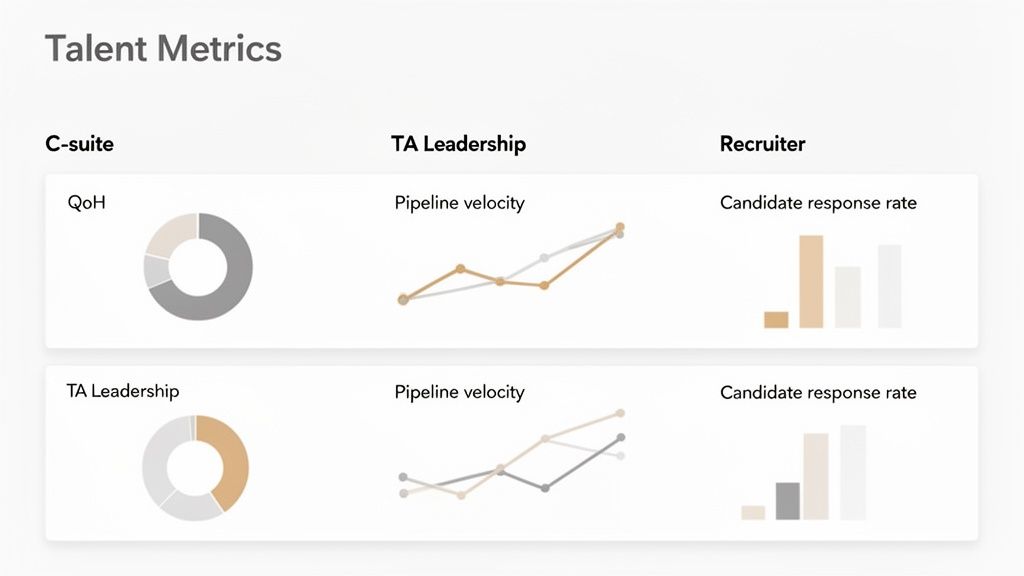
For the executive team, your dashboard needs to connect talent directly to the bottom line. They think in terms of ROI, risk, and competitive advantage.
Here's what they need to see:
Talent acquisition leaders need a clear view of the entire recruiting engine's health. They're focused on efficiency, pipeline health, and the effectiveness of their team.
The core metrics for TA leaders should include:
For individual recruiters, the dashboard isn't a report—it's a daily toolkit. The data needs to be real-time and immediately actionable. Our guide to building a great reporting and analytics dashboard has practical tips.
Essential metrics for a recruiter’s dashboard are:
By tailoring your talent management metrics dashboard to each of these audiences, you stop just reporting data. You start driving decisions.
Tracking talent management metrics isn't an academic exercise—it's about using data to spot problems, predict hiring needs, and make decisions that push the business forward. This is where talent leaders become true strategic partners.
For in-house teams, metrics justify budgets and shape company-wide strategy. They provide the hard evidence to shift from reactive hiring to building a proactive talent pipeline.
Insights from the Global Talent Competitiveness Index 2023 show that top countries attract talent with better promotion prospects and higher wages. For companies, this isn't just trivia; it's a roadmap. This data directly shapes global recruitment strategies, relocation packages, and where to invest in talent development. You can explore more global talent insights on weforum.org.
For recruiting agencies, insightful talent management metrics are what separate you from being just another vendor. Your clients need market intelligence that gives them an edge. Stop just sending a list of candidates. Start delivering a data-driven story. By presenting hard data on where candidates get stuck, you can help clients streamline their recruitment process, improving the candidate experience and preventing top talent from dropping out.
This completely changes the conversation. You’re no longer just filling a job order. You’re providing critical market intelligence that helps your client win the war for talent.
The era of talent acquisition as a purely operational function is over. Simply tracking activity metrics is no longer enough to justify your team's existence or budget.
The new mandate is to operate as a strategic business partner, armed with data that proves a direct line between your talent efforts and the company’s bottom line.
By embracing a framework built on strategic talent management metrics—centered around Quality of Hire, High-Performer Retention, and Internal Mobility—you move beyond the "how fast" and into the "how well." This data-driven approach unlocks the ability to not just fill roles, but to build a more resilient, innovative, and high-performing organization from the inside out.
See how recruiters Juicebox to hire top talent, faster. Sign up now.
Focus on metrics that tie directly to business goals. The most critical are Quality of Hire (QoH), High-Performer Retention, and Internal Mobility Rate. These prove HR's impact on revenue and growth.
Use a weighted index that blends pre-hire signals with post-hire performance. A common formula combines first-year performance review scores (50%), manager satisfaction (30%), and first-year retention (20%).
Start small with data you already have. Employee Retention Rate or First-Year Attrition are great starting points from your HRIS. This builds momentum and shows value quickly without overwhelming your team.
Your reporting cadence should match your audience. Tactical metrics for recruiters are weekly. Operational metrics for TA leaders are monthly. Strategic metrics like QoH for the C-suite should be quarterly.